


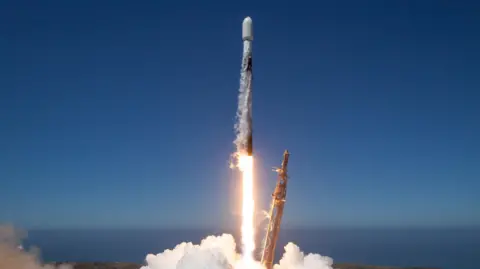
 Private Space Company
Russian orbital vehicles have been tracking British defense orbital systems, according to the chief of Britain's space operations.
During a discussion, Maj Gen Paul Tedman has premierly explained the degree of interference from Moscow against the United Kingdom's satellite network.
He mentioned the Russian government had also been attempting to disrupt the UK's armed forces orbital systems with ground-based systems on a weekly basis.
Last month, Germany's Defence Minister the German official said Russia had been shadowing satellites employed by German armed forces.
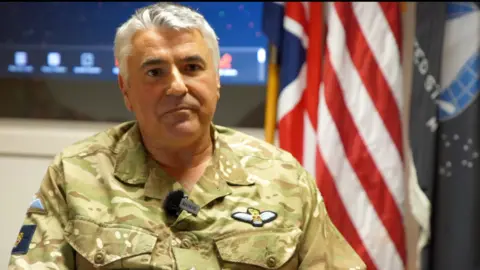
The commander provided information of how Russia was conducting parallel operations to the United Kingdom. "They're interested in what we're doing and approaching closely," he stated.
"They have instruments installed that can see our orbital systems and are trying to collect data from them."
Gen Tedman said the nation's orbital assets had been outfitted with anti-interference systems but commented: "We notice our orbital systems being disrupted by the Moscow on a fairly regular schedule."
Upon questioning the regularity, he replied "every seven days". It was, he said, purposeful and the behavior had escalated since Moscow's comprehensive attack of the Ukrainian nation. The United Kingdom has half a dozen dedicated military satellites in the heavens supplying communications and observation.
Conversely, the US, the Chinese nation and the Russian Federation each have in excess of 100. The aggregate Russian and Chinese spacecraft collection has grown by seventy percent in the previous ten-year period.
The general said Moscow and Beijing had both tried out space warfare systems. Both the United Kingdom and the United States have cautioned that Russia has been creating the capability to put atomic arms in orbit.
Although the United States views China as the pacing threat, Gen Tedman considers Russia as the closer risk: "I would say the Chinese have significantly the developed systems but the Russia have greater determination to employ their counter-space systems."
Gen Tedman said he was "really worried" about what was happening in the cosmos – not just the risks but the increasing congestion. There are at this time about 45,000 objects in orbit including around thousands of orbital systems. The current year will see an additional three hundred space missions into space.

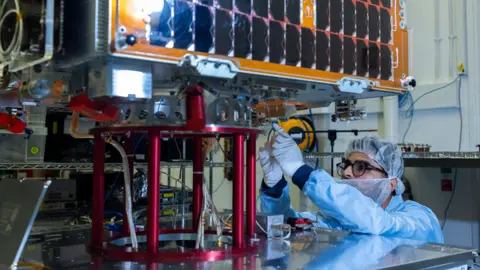 UK MoD
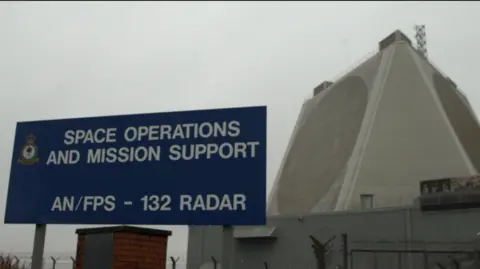
The general was commenting on a inspection to RAF Fylingdales in North Yorkshire. It is home to both nations' missile detection network. It is a mission they has been doing since the 1960s.
The historic three large radomes or "spherical objects" from the historical period have been substituted with a 98-foot geometric building which accommodates thousands of antennae.
It looks like a spacecraft has touched down on the North Yorkshire moors, surrounded by livestock, an powered enclosure and razor wire.
The constant surveillance provides complete visibility from the northern polar region to North Africa, and from the Mediterranean to the international waters. Its detection system can track objects the size of a tin can, 3,000 miles into the cosmos.
Internally, the protective barriers and containment systems tell you that this facility could be a objective for any enemy. In the command center, defense staff observe round the clock, annually.
The military detection team take us through the procedure of how they identify a rocket firing. They are connected to other US satellites and detection devices that permit them to spot a firing globally.
Gen Tedman refers to space "collaborative effort" but, truthfully, the UK is substantially counting on the US. private firms service the detection system at the facility.
The military leader in commanding the watch says together with other information channels "we would detect the UK was in danger probably within a minute."
What is mentioned less is the UK's ability to intercept ballistic missiles. Nowadays the UK has minimal in the way of weapon interception.
The national leadership is committing to invest more in both orbital operations and weapon protection. It is also taking steps to protect its orbital systems. Presently it is declaring it will evaluate monitoring equipment to identify directed energy risks in orbit.
Both the Chinese government and Russia have created lasers which could be used to blind and interfere with an enemy's orbital systems.
The general said: "Our nation has promised to invest a billion pounds into combined threat interception, and it would astonish me if there's not a {space aspect|


